The Second Education · Ari C. Mercer
5 Skills AI Cannot Replace
(And How to Build Them)
Not soft skills. Not buzzwords. Five specific human capabilities that are structurally resistant to automation — with evidence and a development path for each.
Read The Second Education →In 2023, GPT-4 scored in the 90th percentile on the bar exam. AI systems were writing code that passed professional code reviews without modification. The question of what remains distinctively human now has a job market attached to it.
The honest answer is not a long list of safe harbors. Most of what knowledge workers do is pattern recognition and synthesis — exactly what large language models do well. But there are five capabilities where the gap remains substantial, and where human investment still compounds in ways AI cannot easily replicate.
1 of 5
Contextual Moral Judgment
Why AI struggles: AI identifies ethical frameworks and flags probable harms. It cannot exercise genuine moral judgment in situations where the right answer depends on knowing the people involved, the history of the relationship, and consequences no model can anticipate.
How to build it: Practice sitting with ethical complexity rather than resolving it too quickly. Study cases where well-intentioned people reached opposite conclusions.
2 of 5
Relational Trust
Why AI struggles: AI can simulate warmth. It cannot be genuinely accountable — it cannot suffer consequences, be truly surprised, or grow in ways that change its relationships. The trust that matters in leadership, therapy, negotiation, and care requires a real human presence.
How to build it: Have difficult conversations directly. Take accountability when things go wrong. Show up consistently over time. Trust compounds slowly.
3 of 5
Novel Problem Framing
Why AI struggles: AI excels at solving clearly defined problems. It is significantly weaker at stepping back and asking whether the entire frame is wrong — the most valuable cognitive skill in any complex organization.
How to build it: Practice first-principles thinking. Cultivate the habit of asking 'what are we assuming here?' before moving to solutions. Tolerate not knowing.
4 of 5
Embodied and Tacit Knowledge
Why AI struggles: A master carpenter knows things in their hands they cannot fully articulate. Expert physical craft, skilled trades, hands-on care — this embodied knowledge is genuinely difficult to transfer to systems that only process language and images.
How to build it: Learn to do something with your hands — and do it long enough to develop genuine expertise. Embodied skill is a form of resilience that doesn't appear on most development roadmaps.
5 of 5
Integrative Synthesis
Why AI struggles: AI can summarize research across biology, economics, and political theory separately. What it struggles with is the kind of synthesis that requires genuinely holding multiple incompatible frameworks simultaneously and finding the insight that only emerges from that tension.
How to build it: Read across disciplines — not for breadth but for the synthesis that becomes possible. Work in the uncomfortable space between domains.
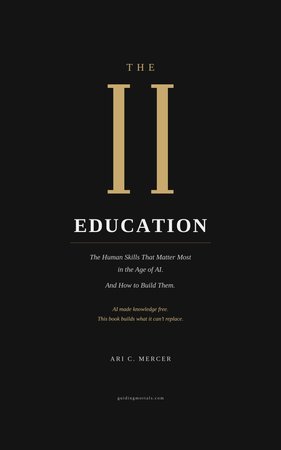
The Second Education
The full framework for building all five capabilities — with evidence and a practical curriculum.
Get on Amazon →Related essays